Wednesday, February 4, 2015

Aging Meats in a Vacuum Sealer Bag


Dale from Dresden, TN asked:

Brad I have a question on aging meats in a vacuum seal bag versus aging in a cooler. Will they both work? 


Thanks for the question Dale! Aging meats is one of my favorites! Yes you can age meats both ways. When you age in the vacuum bag, that's called wet aging. When you hang your meats in the cooler, this is called dry aging. The major difference is flavor. When you dry age the body moisture from the carcass evaporates, thus changing the flavor. When you wet age the meat proteins still break down, making a tender product. However, the evaporation process can not occur so there's a flavor difference.

I prefer the dry aged flavor that comes from hanging in the cooler, but either process will work for tenderness. Standard aging times for most game animals will range from 5-7 days.

 Thanks again for the great question!


Wednesday, October 29, 2014

Wednesday, October 22, 2014

How to Use a Bradley Smoker Indoors


Dion from Manitoba, CA asked:

I noticed on a recent show you had a Bradley smoker going indoors - how did you pipe it outside? I do a lot of home processing but working around the Canadian north's weather is a challenge. I have plenty of room in my shop/garage, just need some advice or ideas for venting!

Thanks,

Dion


Thanks for the question Dion,

I simply put a triple wall pipe up though the ceiling, just like pluming in a wood burner. The only downfall is: on damp days it has a little trouble drafting. So I warm the pipe up by turning the smoker on to 160F for 30 minutes before I turn on the smoke generator. 

If you don't, you'll have a building full of smoke. On of top my Bradley Smoker, I have a piece of flex pipe screwed directly to the top of the smoker over top of the dampener.

Good luck and happy all year smoking!!!

Brad

Wednesday, October 15, 2014

Wild Game Butchering Classes?


Terrance of Seattle, WA wrote in:

I would very much like to hang out/learn from some "pros" how to properly butcher deer (maybe other game). Are you aware of any schools/courses (hands-on) that are available?


Hello Terrance!

I can honestly tell you that there's so much useless knowledge about meat processing stuffed up inside my head, you would go crazy listening to it all. I'm just kidding ya! 

With that being said, the next best thing would be the instructional DVD series that I produce. The Game Processing library has 4 discs in it, plus a 2 hour bonus hunting DVD! 9 hours of knowledge that is step by step, in detail with extreme close up video to match it all up. Each DVD has chapter menus, so you can watch each section as many times as you would like. I have a saying that goes like this: After you watch these DVDs, if you can't process game like a pro - take up knitting!

All joking aside, the closest thing to the DVDs are the 2-hour short courses I do at various events like the NRA National Show and other local events. The DVDs are a great resource that you can watch over and over again. More knowledge than I can share in any email or blog post.

Good luck this season!

- Brad Lockwood, Love of the Hunt TV


Wednesday, October 8, 2014

Proper Hanging Time for Wild Game Quarters


Warren from Alberta, CA asked:

Hi Brad,

I purchased the complete set of your DVDs. I understand what you are saying about the 3 day per 100 pounds.

My question then is: If you harvest a 400 lb moose. You quarter it. Then you are hanging roughly 100 pound quarters.

Is the proper hanging time 12 days or 3 days for each quarter?


Warren that's a very good question and I thank you!

Yes, you will age 12 days for a 400lb moose. The only issue you're going to run into with the quarters is going to be waste. When you quarter the animal, which I realize is the only way to get one out of the field, you create a lot of exposed surface area. That surface area is going to dry out and get dark. But after you trim it off, the meat under will be tender as velvet!

Thanks for the great question and enjoy the moose meat, it's my favorite!

-Brad

Wednesday, October 1, 2014

Custom Sausage Making


Jackie from Quitman, GA asked:
I am wanting to make a combo sausage using deer and rabbit. My question for you is: What fat trimmings should I use and how what is the lbs to lbs ratio. I'm big fan of the blog! Watch you from Youtube!


Thanks for the question Jackie!

That's a very interesting product! I'd love to try that someday.

The rule that I apply concerning what type of fat to use is based upon what product I'm trying to duplicate. For example, if I'm making a summer sausage which is traditionally a beef product I will mix beef trim or beef fat in with my game meat. If I'm making Kielbasa or Bratwurst which is typically a pork based product, I will add pork back fat or pork butt trimmings.

It sounds like you're making a basic sausage product, which would traditionally be a pork based product, so I would use pork back fat or pork butt trimmings.

A desirable fat to lean ratio is typically 80/20. If you trim your game meat lean, which you should, and dispose of all that off-flavored wild game fat, you will have a very lean product. That's why we love game meat so much, right?! It's lean and healthy!

After the fat is trimmed, you should have a 95-98% lean product, so if you want an 80/20 (80% lean and 20% fat) blend then you would need to add 1.5 lbs of pure back fat with 8.5lbs of good lean trim for a 10 lb batch.

Be careful using pure back fat. If you add a little too much it can be a lot! If you don't add enough, you'll never notice that it's even in the product. Pure fat can be a little tricky. It's generally not expensive to get, but it can be touchy when adding enough or not enough.

Now, when using pork butt trimmings, you will also have some lean pork in there, so the window of too much or not enough increases. You can use 3 lbs of pork butt trimmings and 7 lbs of game meat for each 10 lb batch. You have a much larger window of error. Next, mix your seasonings and a little water to blend the seasonings - and you're ready to grind!!

Good luck and thanks for the great question!

Brad Lockwood

Wednesday, September 24, 2014

Thickness and Timing for Perfect Jerky

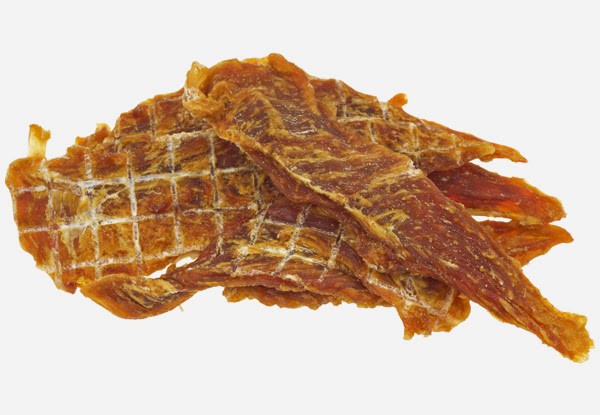
This is a thicker, 1/4" sliced jerky


Paul Eckert of Jasper, IN wrote in:

Brad,
I am a disabled vet that spends alot of my time hunting and fishing. I love to make deer jerky, but have had problems with some jerky getting done to hard and some not all the way. I use a dehydrator for making jerky. I have since bought a cheaper meat slicer to get exact cuts. What thickness do you recommend when cutting the meat for a dehydrator? How long do you recommend dehydrating?


Thinner, 1/8th-inch sliced jerky


Great Question Paul,

You're on the right track by purchasing a meat slicer! That will give you a more consistent thickness on your strips. A jerky slicer is even better because it's already gauged to the proper thickness, so you don't have to turn a knob to set the thickness. When you have different thicknesses, thin strips will be overcooked and thick strips will be undercooked, so you're on the right track. Thickness depends on your own personal preference. I'd say 3/16 - 1/8th of an inch is good for a dehydrator. I wouldn't go any thicker than that in a dehydrator because of the low drying temperature.

Now for the rest of your question. You're also on the correct track: the amount of meat you place in the dehydrator is going to change the length of time you dry for. More meat equals longer drying times. With that being said, I hope you can see that making the same size batches every time is just as important as slicing the strips at the same thickness. It all works together, adding the seasonings to the correct poundage of meat, slicing the same thickness and drying according to the amount of product loaded into the smoker or dehydrator.

I really can't give you an exact drying time because the time will vary according to the amount of meat placed into the dehydrator or smoker. My method for checking my finished jerky product is a two step process. First I squeeze the jerky to be sure I no longer feel that "sponge texture" to the meat, however I still like to be able to flex and bend the jerky strip without it breaking, If it breaks, it's too dry, and if it still feels "spongy," then I have raw spots in the center of the strip. I then log the amount of time I dried the product and now I have a formula for the next batch!

I hope this helps and remember it's all about consistency - in thickness, seasoning, batch size and drying time. Be consistent and you will be making jerky like a pro!

Thanks for the question Paul!